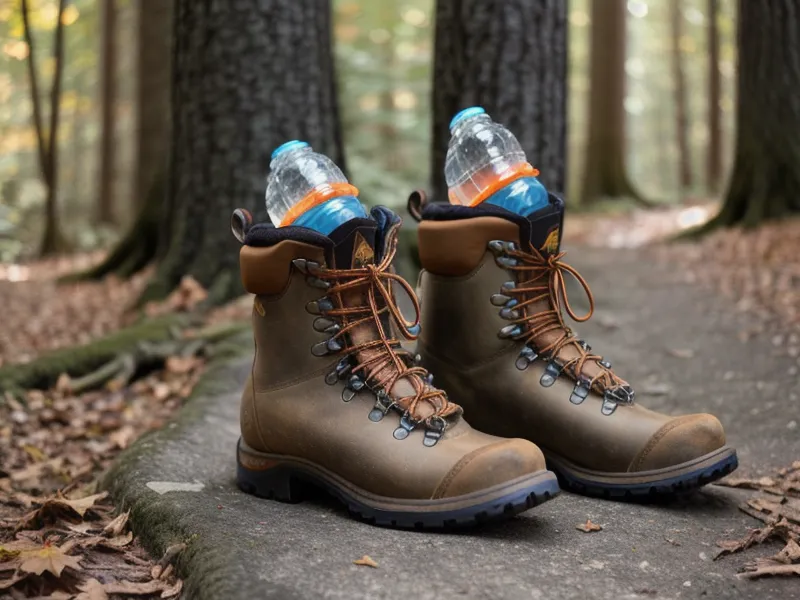
Two hikers the same age can hit the same climb and one walks down easy while the other grabs the railing. I spent a long stretch as the second one. Hip mobility after fifty doesn't fail all at once, it erodes quietly until a flight of stairs makes the truth obvious. This isn't a diary entry about how that felt. It's the actual breakdown of what I check before deciding a hike, a stretch, or a supplement is doing anything real for joint mobility, hiking after fifty, or synovial fluid health.
Quick housekeeping before the breakdown: this piece has affiliate links, and if you buy through one I earn a small commission at no extra cost to you -- I only mention things I've put through a full hiking season, not whatever pays best. I've spent two years now treating my hips like a system instead of a complaint department, and the first thing I had to unlearn was the push-through-it instinct. Loading an already-inflamed joint with more impact isn't toughness -- it's just a slower route back to the couch. That's basically the whole premise behind Beyond the Heavy Boot: My Shift to Low-Impact Hiking After Fifty, and it's the starting assumption for everything below.
The Real Test For Hip Mobility After Fifty
Real improvement doesn't announce itself on the trail first. Willpower can carry you up a climb even on a bad day, so the trail is actually the worst place to judge whether something is working. The way I test it now is closer to checking a map before committing to an unfamiliar loop -- you look for the boring, unglamorous signal before you trust the exciting one. For hip mobility specifically, that boring signal usually shows up in a doorway or a car seat long before it shows up on a summit.
Synovial Fluid Explains Less Than The Marketing Wants You To Think
Here's the one-sentence version, because the full explanation lives in another post of mine -- Synovial fluid is what keeps a joint moving smoothly, and the molecule most responsible for keeping it thick enough to matter is Hyaluronan. That's as far as I'll go here -- I'm not a doctor, I have no medical training, and there's a whole separate article on this site that already covers the mechanics properly. What matters for this breakdown is simpler: does whatever you're trying change how a joint feels three hours into a climb, or does it just change how convincing the label sounds standing in a store aisle.
Is It The Supplement, Or Is It The Poles?
This is where I have to admit I can't hand you a clean experiment. Two things changed around the same stretch, and I can't fully separate their effects. I started taking Joint Genesis [My Daily Pick] because it's built around supporting fluid density specifically, one capsule a day, rather than throwing a general anti-inflammatory at the problem -- and around the same time I finally started using trekking poles instead of leaving them in the trunk out of stubbornness.
My neighbor Tom borrowed a spare pair of mine for one descent at Blue Hills Reservation and came back a full convert -- bought his own within the week and now talks anyone who'll stand still long enough into trying them. I can still hear the tick of pole tips on the cold asphalt in that parking lot before the trail even starts, nothing like the softer strike once you're on dirt. So which one actually helped? Probably both, honestly, but on different timelines -- the poles took load off my knees on the way down that same afternoon, no waiting required. The capsule was slower. Days went by with nothing obvious before I noticed any difference at all, and if I'm skeptical of anything I mention here, it's the idea that a supplement should feel dramatic. The guarantee window on that one runs about six months, which is long enough to actually find out instead of guessing too early and giving up.
Separating A Good Week From An Actual Fix
The test I actually trust isn't on a trail at all. I went down my own basement stairs not long ago without grabbing the railing, feet just finding each step on their own, and didn't register it until I was standing at the bottom wondering why that felt so uneventful. That's the kind of moment that counts -- not the hike I can talk myself through on stubbornness, but the ordinary one where my body just does the thing without a negotiation first.
Before I found anything that actually held up, I tried a cortisone injection on the idea that it would buy me a season of pain-free hiking. It helped, for a while. Then the ache came back in the exact same spot, and I was right back to treating stairs like a negotiation. That's not a knock on cortisone as a tool -- it's proof that a temporary fix and a real one feel identical at first, which is exactly why the stairs test matters more than how good the first few days of anything new feel.
If glucosamine has worked for you in the past, or your issue is general inflammation rather than a lubrication problem specifically, JointVive [Classic Approach] leans into that older, more established combination, with turmeric folded in for active days. I didn't go that route because mine tested out as more of a dry-hinge issue than an inflamed one, but the two aren't competing theories -- they're answers to different questions, and it's worth sorting out which question you're actually asking before you commit a season to either.
That "everything is a personal insult" phase deserves its own space, and I wrote about climbing out of it in Moving Past the 'Angry Six Months': What a Year of Prioritizing My Joints Actually Taught Me. This piece isn't that story. It's the checklist version -- the part where I stopped narrating my feelings about it and started tracking whether anything I tried actually moved the needle.
Mechanical Load Versus Chemical Support On The Trail
If you hate the idea of another capsule and your problem is specifically knees rather than hips, there's a real case for going straight at the mechanics first. Ageless Knees [No-Pill Option] is built around exactly that -- home exercises aimed at knee mobility rather than anything you swallow, and it pairs fine with whatever else you're doing since it's not competing for the same job. It won't touch a hip or a shoulder, and it asks you to actually show up and do the work without anyone standing over you, which is its own kind of honesty about who it's really for.
So if you're trying to figure out whether any of this is worth your money or your patience, skip the trail as your test -- willpower can fake a good hike every time. Watch the boring stuff instead: the stairs, the car door, the moment you stand up from a low chair without doing the little countdown in your head first. That's where a real fix shows up before anything else does. The one that's stayed in my own bag the longest is the one built around fluid density rather than general inflammation, and if you want to run the test against it yourself, you can check out Joint Genesis here.