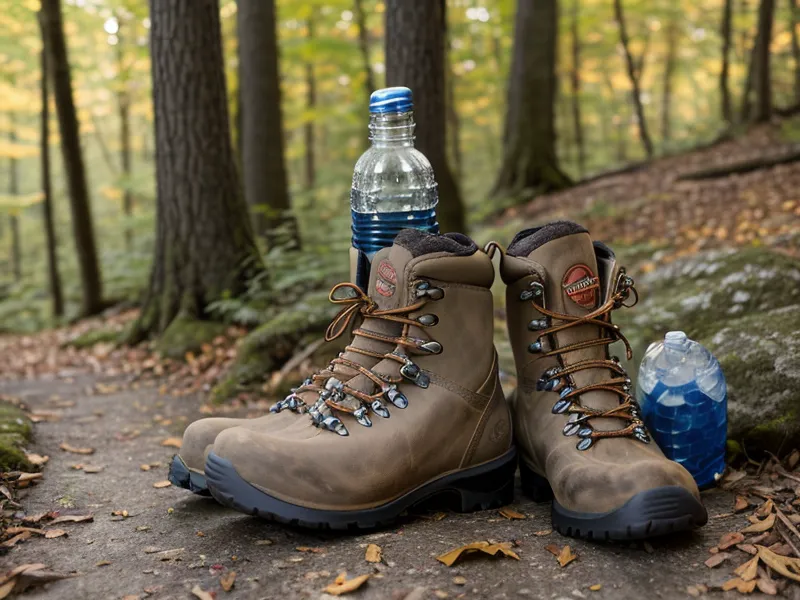
My knee buckled sideways on a loose patch of gravel before I even registered I'd stepped wrong. I grabbed for the trailside oak next to me, bark scraping rough against my palm, some old reflex firing half a second ahead of actual thought. That was on the switchback down from Moose Hill Wildlife Sanctuary, the stretch where the trail drops fast and your knees end up doing all the work your hips used to share, the kind of trade-off that chips away at joint mobility long before you're ready to admit it.
Twenty years of weekend hikes taught me to trust my body on ground like that without a second thought. About two years ago, that trust started costing me. Quick disclosure before I go further: this post has affiliate links in it, and if you use them I earn a small commission at no extra cost to you. I only mention things I've actually tried in my own unglamorous quest to keep hiking.
There's an emotional cost to losing that kind of trust nobody warns you about, and staying active past fifty apparently means making peace with it — the dull ache that shows up two days late, the hip that locks up if I sit too long afterward. Some days I still miss what an easy ten miles used to feel like, back when I never thought about my knees at all.
Joint Mobility Isn't Just a Physical Problem
Here's the thing nobody tells you about stiffness setting in — the hardest part isn't the pain itself. It's watching an identity slip sideways. For about six months I was furious, treating my knees and hips like a couple of employees who'd stopped listening, figuring if I pushed hard enough they'd fall back in line. They did not fall in line. Joints don't negotiate.
Being a "hiker" for two decades and then suddenly becoming the person who waits at the trailhead — that's its own kind of grief, and nobody warns you it's coming. I spent one whole winter on the couch, watching the calendar, telling myself I'd get back out there once things settled down. They didn't settle down on their own. I even bought one of those guided mobility programs and then sat there staring at the login screen for an embarrassingly long stretch, too discouraged by day one to press play.
So What Do You Do When You Can't Just Rest?
Most advice aimed at people my age is built around pacing and resting, which is fine until life doesn't let you do either. My two-year-old grandson went through a phase where he was basically a heat-seeking missile for anything dangerous, and one afternoon he made a beeline for the top of the basement stairs. I hesitated, half a second no more, because I knew exactly what my knee would do if I had to lunge for him.
Look — that's where the guilt lives. When you're the one watching a toddler, joint pain stops being a personal inconvenience and turns into a safety question you don't get to opt out of. You can't ask a two-year-old to hang on while you deal with your hip. That afternoon convinced me I couldn't just white-knuckle through this. I needed the joints themselves working better, not just a stronger will to ignore them. Worth saying plainly: I'm not a doctor or a physical therapist, so talk to your own before changing anything based on what worked for me.
Lubrication, Not Just Structure
A friend of mine — golf became her thing once her knees got cranky, trading trail days for the course — mentioned offhand that she'd started taking something for her joints. When I asked what convinced her, she didn't say "more cartilage." She said "lubrication," and that sent me down a rabbit hole into synovial fluid. I'm not going to pretend I can explain the biology of it properly — that's a conversation for people with actual credentials — but the basic idea stuck with me: losing cartilage and losing the fluid that keeps things sliding smoothly aren't the same problem, and they don't get solved the same way.
She'd started on Joint Genesis, and my first reaction was the classic "I'm not a supplement person" eye-roll. Then I remembered I was quickly becoming a "sits on the couch and complains" person instead, which is worse. What actually got me to try it was how simple it is — one capsule, once a day, no juggling a dozen bottles — and it skips shellfish, gluten, and dairy, which matters when your stomach is about as unpredictable as your knees these days. I'd already tried plain glucosamine tablets on my own, for months, before any of this, and felt exactly nothing from them.
If glucosamine is more your speed despite my track record with it, hyaluronan — the ingredient that's supposed to help that fluid stay thick — shows up in different forms across different products, and something like JointVive leans on a glucosamine and chondroitin combination instead. It's more capsules than I want to deal with, and it's off the table if you're allergic to shellfish, but if the classic approach ever worked for you, that's the more familiar route.
Learning to Take the Shorter Loop
Six weeks or so after I started paying attention to any of this, I noticed something small at Moose Hill. I'd turned to check the trail behind me on a downhill stretch — the kind of turn where your weight is already committed to the slope — and I did it without bracing first. That's not a big deal to anyone watching. It was a very big deal to me.
A handful of other adjustments have added up since then, none of them dramatic on their own. Trekking poles take enough weight off my knees on the downhills that I notice the difference by the time I'm back at the car. Shoes matter more than I used to think, too — the cushioning breaks down long before a pair looks worn out, so I stopped waiting for visible damage before replacing them. Sitting at a desk all week turned out to be its own problem, separate from the hiking itself — my hips are stiffer walking out to the trailhead than they are an hour into the hike, which tells you something about where the real damage gets done. A short stretch most evenings seems to wake up muscles at the front of my hip that I'd otherwise forget I have.
Diet turned out to matter too, in ways I didn't expect — what I eat before a long hike affects how swollen my knees feel the next morning. Mobility and flexibility turned out to be two different things I'd been treating as one for years. Going downhill asks more of your joints than going up ever does, which nobody mentions until your quads are shaking on the way down. None of the progress came from pounding my joints harder to build strength, either — it came from steady, controlled loading, not heavier weights or more impact.
That two-mile loop at Moose Hill three weeks ago wasn't the hike I would have done at thirty, and I've stopped measuring it against that version of myself. What actually shifted wasn't one single fix — it was learning to notice the small proof points instead of waiting to feel completely normal again, because completely normal isn't coming back, and waiting for it just burns through years you could be spending on the trail instead.
If any of this sounds familiar, you're not imagining the grief of it, and you're not ridiculous for grieving a hobby. Some days call for finding a new rhythm on the trail instead of forcing the old one, some call for rethinking how you load your knees in the first place, and some call for building strength at home between hikes. I still reach for Joint Genesis most mornings, not because it fixed two years of stiffness, but because it's one less thing working against me.
The woods don't keep score of how fast you move through them. They just care that you showed up. Catch you out there — slower loop's just fine by me.